Kyoto in Fall: A Practical 4-Day Itinerary
The short answer: four days in Kyoto in fall
Four days in Kyoto in fall work best as four geographic blocks: Fushimi Inari and southern Higashiyama; Arashiyama and Sagano; northern and central Kyoto; and the eastern temple corridor from Ginkaku-ji to Nanzen-ji. Give each area its own day, use trains and subways for longer transfers, and keep one evening open for an autumn illumination.
This itinerary balances temples, gardens, neighborhood walks, and time to sit down. It assumes four full sightseeing days and selective early starts. Mid-November into early December is a useful foliage planning window. For 2026, start with the site-specific forecasts below, then use current garden reports to choose your stops; there is no single peak date for the whole city. The gardens and buildings remain worthwhile when your dates miss the strongest leaves.

Cover photo: Daniel Beauchamp / Unsplash.
Jump to
- The Four-Day Route at a Glance
- When Kyoto’s Fall Color Actually Appears
- Getting Around Kyoto in Fall
- Day 1: Fushimi Inari and Southern Higashiyama
- Day 2: Arashiyama and Sagano
- Day 3: Northern and Central Kyoto
- Day 4: Ginkaku-ji, the Philosopher’s Path, Eikan-do, and Nanzen-ji
- Keep, Swap, or Skip
- Check Before You Go
- Frequently Asked Questions
The Four-Day Route at a Glance
| Day | Route | Check first |
|---|---|---|
| 1 | South + southern Higashiyama — Fushimi Inari, Kiyomizu-dera, Sannenzaka, Ninenzaka, Yasaka Shrine, Gion | Seasonal closing and night-viewing dates |
| 2 | Arashiyama + Sagano — Tenryu-ji garden, Bamboo Grove, Togetsukyo Bridge, riverside | Cloud Dragon hall season and current building notices |
| 3 | North + central — Kinkaku-ji, Ryoan-ji | Castle entry cutoff; Honmaru reservation |
| 4 | Eastern temple corridor — Ginkaku-ji, Philosopher’s Path, Eikan-do, Nanzen-ji | Eikan-do seasonal tickets; Nanzen-in closure |
Full four-day itinerary: stops, autumn details, pace and transport
Scroll horizontally to see all columns.
| Day | Main area | Core stops | Optional stop | Fall-specific value | Reserve / verify priority | Pace | Main transport |
|---|---|---|---|---|---|---|---|
| 1 | South + southern Higashiyama | Fushimi Inari, Kiyomizu-dera, Sannenzaka, Ninenzaka, Yasaka Shrine, Gion | Longer Inari climb, replacing other stops | Kiyomizu hillside color | Seasonal closing and night-viewing dates | Fullest, hilly day | JR or Keihan; Keihan north; walk |
| 2 | Arashiyama + Sagano | Tenryu-ji garden, Bamboo Grove, Togetsukyo Bridge, riverside | Cloud Dragon hall or one extension | River and wooded hills | Cloud Dragon hall season and current building notices | Moderate; park viewpoints add climbing | JR Sagano or subway + Randen |
| 3 | North + central | Kinkaku-ji, Ryoan-ji | Nijo-jo, if time allows | Pond gardens and reflections | Castle entry cutoff; Honmaru reservation | Moderate, with a transfer decision | Subway + short bus; walk or local transport |
| 4 | Eastern temple corridor | Ginkaku-ji, Philosopher’s Path, Eikan-do, Nanzen-ji | One paid Nanzen-ji area | Gardens along a southbound walk | Eikan-do seasonal tickets; Nanzen-in closure | Full walking day; shorten as needed | Subway + bus approach; Keage subway return |
Route and general visitor details checked September 30, 2026; foliage sources and selected seasonal notices were rechecked November 3, 2026. Recheck official schedules for your dates; this is a route plan, not a prediction of leaf color.
Who This Itinerary Is For
This suits independent first-time visitors who want Kyoto’s major sights without turning every day into a temple checklist. Couples, friends, and solo travelers can follow the same structure, with lunch and rest stops chosen on the day.
Expect sustained walking, slopes, steps, and time standing in queues. Distance depends on your accommodation and optional climbs, so a single daily mileage would be misleading. Families and travelers with limited mobility should reduce each day to one or two anchors and check individual entrances before committing.
When Kyoto’s Fall Color Actually Appears
Why no one can promise a peak date
For foliage-focused planning, mid-November into early December is a useful window, not a guaranteed peak. Kiyomizu-dera’s seasonal guide describes that period for its leaves and explicitly notes annual variation. It does not establish one peak date for the entire city.
October visits can use this same route with more emphasis on architecture, gardens, and the river. In November, build flexibility around actual color reports. In early December, check shorter opening hours and remaining color before deciding which gardens deserve extra time. Avoid chasing an assumed sequence of “higher first” or “sheltered last” without local evidence.
What the 2026 foliage forecasts mean for this trip
The forecasts help you choose a planning window, but they measure different things:
- Japan Meteorological Corporation, October 1: its Kyoto forecast is November 27 for yellow ginkgo and December 11 for red maple. Both are classified as near normal. These dates estimate when most leaves on the observation tree have changed color; they are not a peak date for every Kyoto garden. Read the forecast and its definition (Japanese).
- Weathernews, checked November 3: its Arashiyama page (Japanese) forecasts good viewing from around November 22 and the start of leaf fall from around December 8. This is a local forecast, not a citywide promise.
Our planning recommendation: consider late November into early December if foliage is your priority, while keeping the four-day route flexible. This is an editorial judgment based on the forecasts and event calendar, not a guarantee of continuous peak color between those dates.
On a small screen, swipe the table to see all columns.
| Your dates | How to plan the route |
|---|---|
| Nov 11–19 | Keep architecture and gardens central to the trip. Eikan-do’s daytime autumn exhibition starts Nov 11; do not assume the best color has arrived everywhere. |
| Nov 20–30 | Evening events begin during this window; Arashiyama’s forecast points to good viewing from around Nov 22, not the whole period. Kiyomizu-dera’s night visits run Nov 21–30. Choose an evening event you actually want to see. |
| Dec 1–6 | Check remaining color locally. Eikan-do’s daytime autumn exhibition and Tenryu-ji’s daily Cloud Dragon hall season finish Dec 6. December hours are shorter at Ginkaku-ji and Nanzen-ji. |
| Dec 7–14 | Prioritize fresh garden reports over a city forecast date. Some autumn events have ended, and Tenryu-ji’s Cloud Dragon hall normally returns to weekends and public holidays, subject to closures. |
For evening plans, Kiyomizu-dera lists closing at 9:30 p.m., with last entry at 9 p.m., during its November 21–30 night visits. Eikan-do’s published notices disagree on the final night: the Japanese notice lists December 6 and the English notice December 10. Confirm directly before planning a visit at the end of that period; see the Day 4 notes.
Foliage sources and the listed Kiyomizu-dera, Eikan-do, and Tenryu-ji seasonal notices rechecked November 3, 2026. Check current conditions before paying for an optional garden visit; an event’s operating dates do not guarantee foliage quality.
Check conditions, not last year’s photographs
Use the official Autumn Leaves Calendar for dated local information. At our November 3, 2026 check, its heading identified the 2026 season and its stated last-update date was October 30. Check the date of each location’s report before planning a visit; the downloadable 2025 calendar is historical context, not evidence of current color.
Bookmark Kyoto’s congestion forecast, live cameras, and Smart Navi tools. Check the areas you intend to visit the evening before and again before leaving. A crowded camera view can justify a later lunch, a shorter stop, or swapping whole days. It does not guarantee the next street will be empty.
Planning Assumptions Behind This Route
Arrive the evening before Day 1; departure travel is outside these four days. If Tokyo is your next stop, allow time for the train journey before starting our four-day Tokyo itinerary. Start early on Days 1 and 2, leave room for meals, and keep optional stops genuinely optional. No out-of-town day trips are built in.
Use the nearest useful station to your hotel instead of returning to Kyoto Station between visits. Rail reduces exposure to road traffic, but trains can also be busy or disrupted. Keep enough time to change plans when a connection or queue runs long.
What to Reserve, What to Verify, What to Leave Flexible
Reserve in advance
Book accommodation once your dates are firm. If the Honmaru-goten Palace at Nijo-jo matters to you, its official ticket page requires an advance web ticket, released 30 days before the visit. Castle admission is additional. Ordinary castle and Ninomaru-goten visits do not require that Honmaru reservation.
A fixed palace time should become the day’s anchor. Do not book it while treating the castle as an optional late-afternoon extra.
Verify close to departure
- Kiyomizu-dera: seasonal daytime closing and the November 21–30, 2026 night-viewing window.
- Tenryu-ji: check the Cloud Dragon hall’s autumn dates and any ceremony-related interior closures separately from the garden’s opening arrangements.
- Eikan-do: seasonal fees, separate day/night entry, and the conflicting night end dates explained under Day 4.
- Nijo-jo: the exact palace’s closure calendar, not just whether the castle grounds open.
- Special events: ticket methods and admission conditions can differ from ordinary daytime visits.
Leave flexible
Leave the Mount Inari climb, extra temples, paid interiors, and evening illumination open until you know your energy and conditions. An ordinary daytime ticket should never be assumed to include an evening event.
Where to Stay for This Itinerary
Choose a base by its actual station walk and useful lines. These three areas support the route in different ways:
- Kyoto Station: convenient for arrival luggage, JR to Inari and Saga-Arashiyama, and the Karasuma subway. Check which side of the large station your accommodation occupies.
- Karasuma Oike or the Karasuma–Shijo corridor: useful central access; Karasuma Oike connects the city’s two subway lines. Compare the station entrance, not just the neighborhood name.
- Gion or the Keihan corridor: useful for evening walks and the Fushimi Inari connection. Western Kyoto days still require planning, and residential lanes deserve quiet.
Before booking, trace one morning journey to Arashiyama and one to northern Kyoto. A slightly less scenic hotel with a straightforward station walk may suit these four days better. Arrange luggage storage or delivery for arrival and departure rather than taking large cases on sightseeing buses. Use the hotel selection checklist to compare the room, total cost, and booking conditions as well.
Kyoto stays
Find a base for your four-day route
Enter your dates and guest count, then compare the station walk and routes for these four days alongside the exact room, full price and cancellation terms.
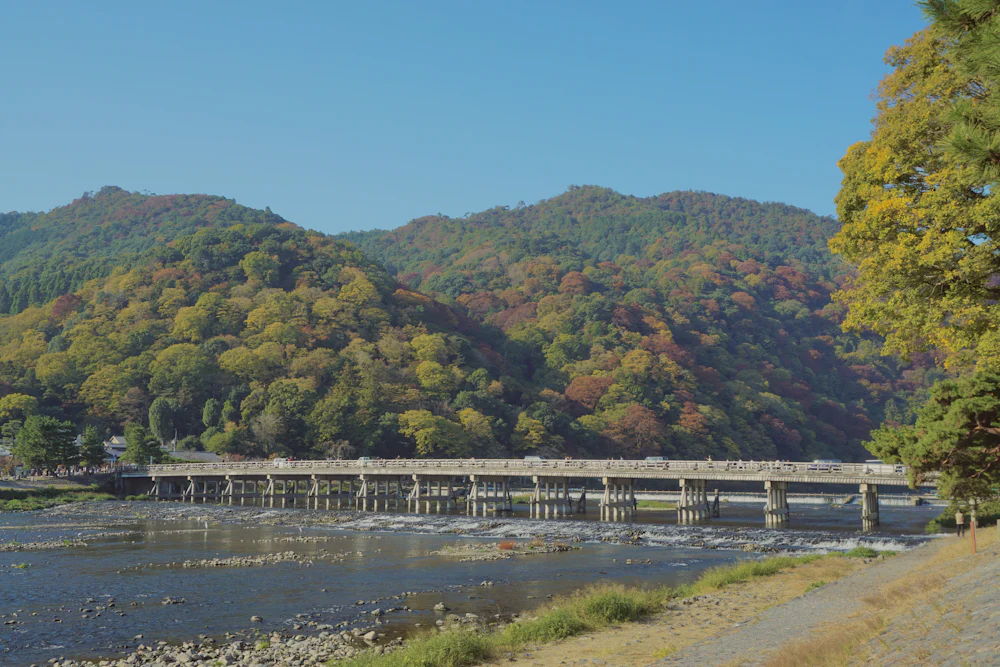
The photo shows Arashiyama’s riverside setting, not a hotel or room.
Affiliate link: BoardingNotes may earn a commission if you purchase through this link.
Compare Kyoto stays for your datesGetting Around Kyoto in Fall
Rail for longer links, buses where they help
Kyoto’s official guidance recommends a subway-and-Randen approach to Arashiyama and subway plus a short bus to Kinkaku-ji. Both are alternatives to relying on long cross-city bus rides.
When a bus helps
The sightseeing limited express buses are another option on operating days: EX100 serves Gion and Ginkakuji-mae; EX101 serves Gojo-zaka. They run on weekends and holidays under the published service pattern. Check the operator’s current timetable; traffic still affects them, and they are not the opening-time approach used on Day 4.
Fares, IC cards, and the pass calculation
| Transport or ticket | Adult | Child |
|---|---|---|
| City bus within the flat-fare zone | ¥230 | ¥120 |
| Sightseeing limited express, one ride | ¥500 | ¥250 |
| Subway, depending on distance | ¥220–¥360 | ¥110–¥180 |
| Subway & Bus 1-Day Pass | ¥1,100 | ¥550 |
Check bus fares, subway fares, and the pass coverage map. The pass covers one calendar day, including the sightseeing limited express, but not JR, Keihan, or Randen trains. References to covered JR or Keihan services concern designated bus routes.
Use actual journeys to decide: two ¥260 subway rides plus two ¥230 bus rides total ¥980, below the ¥1,100 pass. Adding a third such bus ride brings the total to ¥1,210. That is an example, not the fare for every day here. Days 1 and 2 may use railways outside the pass.
ICOCA, Suica, and PASMO are accepted on Kyoto City buses and subway. An IC card is a payment method, not unlimited travel. Load it before a busy journey, and do not assume a contactless bank card has identical acceptance.
Day 1: Fushimi Inari and Southern Higashiyama
Start at Fushimi Inari
From Kyoto Station, take a JR Nara Line service that stops at Inari; the shrine’s access guide places it two stops away. From the Keihan side of town, use Fushimi-inari Station instead. Start early in daylight, without expecting empty paths.
How far up the mountain should you go?
For this itinerary, visit the main shrine and the lower Senbon Torii route toward Okusha, then turn back when you have had enough. Yotsutsuji is a longer uphill extension, not another name for the short lower-gates walk.
The full mountain circuit is a different commitment: JNTO estimates two to three hours, with pace and stops affecting the visit. If that climb is your priority, reduce the afternoon rather than adding it to the full day. Carry water and give yourself a clear turnaround point.
Take Keihan north to Kiyomizu-dera
Walk to Fushimi-inari Station and take a northbound service stopping at Kiyomizu-Gojo. This avoids returning to Kyoto Station. Kiyomizu-dera lists about 25 minutes on foot from Kiyomizu-Gojo, with an uphill approach; allow more for your pace and congestion.
Kiyomizu opens at 6 a.m., but closing varies seasonally. Use the temple’s designated approaches and check the current hours. Do not mistake a bus stop near the district for a ride all the way to the main hall.
Spend your time on the temple and hillside views, then take a lunch break before the lanes below. For November 21–30, 2026, the announced night viewing runs until 9:30 p.m., with last entry at 9 p.m. Verify admission arrangements; an evening return adds both walking and another queue.
Walk through Higashiyama toward Gion
Continue through Sannenzaka and Ninenzaka, then toward Nene-no-Michi, Maruyama Park, Yasaka Shrine, and Gion. This generally takes you downhill from Kiyomizu, but includes steps, uneven surfaces, and crowded pinch points.
Keep the lanes and neighborhood walk; skip additional temple interiors if the morning ran long. Gion works as a brief evening stroll and dinner area. It is also a residential and working district, so follow signs about private lanes and photography.
Day 2: Arashiyama and Sagano
Give western Kyoto its own day
Use the JR Sagano Line to Saga-Arashiyama, or take the subway to Uzumasa Tenjingawa and transfer to Randen at Randen-Tenjingawa for Arashiyama. The city’s rail alternative is useful when your base suits it; it is not a promise of a quieter carriage.
Start with the garden opening rather than an elaborate sunrise schedule. If you visit the Bamboo Grove first, remember that temple ticketed areas follow their own hours.
Tenryu-ji, bamboo, and the river
Tenryu-ji’s garden opens 8:30 a.m.–5 p.m., last entry 4:50 p.m. Garden admission is ¥500 for high-school age and above; buildings cost another ¥300. Choose whether you want those interiors before buying.
The Cloud Dragon ceiling is a separate ¥500 visit, with daily autumn opening scheduled September 19–December 6, 2026, apart from closures. Hall hours are 9 a.m.–4:30 p.m., with last entry at 4:20 p.m. Check current closure notices before adding the ceiling visit; the garden remains the core of this day.
Continue from the north side toward the Bamboo Grove, then work back toward the river and Togetsukyo Bridge. The bamboo path and riverside walking areas are distinct from the paid temple garden. Pause for lunch before deciding how much more to add.
Choose one extension
A slower Sagano walk, one nearby temple, or time in Kameyama Park is enough. The park’s hillside viewpoints add climbing; the riverside is the easier choice when legs are tired. Check the specific path before relying on step-free access.
Keep the late afternoon in western Kyoto. Crossing the city to rescue a missed eastern temple would use the time you set aside to enjoy this area.
Day 3: Northern and Central Kyoto

Kinkaku-ji
Take the Karasuma subway to Kitaoji and a short bus connection toward Kinkakuji-michi; the city guide includes bus 205. Check the current stop and direction before boarding. Kinkaku-ji lists 9 a.m.–5 p.m. visiting hours and ¥500 general admission.
Ryoan-ji
Continue west to Ryoan-ji by walking or a suitable local bus. Compare the actual walking route with live transit directions rather than treating a straight line on the map as a transfer time. Take lunch before deciding on the castle.
Ryoan-ji offers a change of emphasis: the dry rock garden, then the larger grounds and pond. Give yourself time to sit. The city’s visitor listing links to the temple’s own site; check current admission and opening hours before going.
Nijo-jo is conditional
Use 2 p.m. as a decision point, not an arrival guarantee. If you are leaving Ryoan-ji then, check the live journey, energy level, and castle entry cutoff. The Randen-and-subway option involves transfers; a bus or taxi remains subject to traffic. If you cannot allow an unhurried visit, skip the castle.
Castle admission ends at 4 p.m.; grounds close at 5 p.m. Admission is ¥800 for the castle, or ¥1,300 including Ninomaru-goten. Honmaru-goten costs another ¥1,000 and requires its own advance booking.
Ninomaru has Tuesday closures in December, as well as January, July, and August; do not apply that rule automatically to October or November. Honmaru has its own third-Monday-and-following-day pattern, with holiday exceptions. Check the official calendar for the particular palace. Leave via Nijojo-mae on the Tozai Line.
A slower central finish
If you skip the castle, finish with a meal or slow central walk. A free afternoon is more useful than another hurried admission.
If you would rather replace an optional sightseeing stop with a tea experience, Tiqets lists a 45-minute matcha session at aeru gojo in central Kyoto. It may fit the slower central finish on Day 3 if you skip Nijo-jo and choose a compatible session. Check the meeting point, travel time, available hours, and cancellation terms before booking. For a learning-focused stop, check how much preparation you will do yourself, the language of the explanation and the seating arrangement. If you simply want to drink matcha and rest, leave a café stop unbooked instead. Choose the session only if that guided element matters to you; a fixed appointment reduces the freedom to shorten or extend the northern-temple visits.
Affiliate disclosure: BoardingNotes may earn a commission if you purchase through the link below.
Check the Kyoto matcha experience on Tiqets
Day 4: Ginkaku-ji, the Philosopher’s Path, Eikan-do, and Nanzen-ji
Begin at the northern end
From Kyoto Station, use the Karasuma subway to Imadegawa, then bus 203 toward Ginkaku-ji, following the city’s recommended access route. There is still an uphill approach. Starting at Keage would send you north before retracing the corridor south.
Ginkaku-ji opens 8:30 a.m.–5 p.m. through November and 9 a.m.–4:30 p.m. from December; general admission is ¥1,000. Enjoy the garden before beginning the southbound Philosopher’s Path walk. The garden’s upper route adds climbing.
Take the path in sections, with a café or lunch break. It is a neighborhood route, not a reason to walk continuously when tired. Shorten the walk or one garden visit if you are losing daylight.
Eikan-do’s 2026 autumn arrangements
The temple’s Japanese announcement lists the autumn daytime exhibition for November 11–December 6, 2026: entry 9 a.m.–4 p.m., closing 5 p.m., adult admission ¥1,500. Normal-period pricing should not be substituted for this seasonal ticket.
Night admission is ¥1,000, opening at 5:30 p.m., last entry 8:30 p.m., closing 9 p.m. The official pages disagree on the final night: Japanese lists November 20–December 6, while the English notice lists November 20–December 10. Confirm directly with the temple before planning around the end of that window.
Day and night visits use separate tickets, with visitors cleared between sessions. An illumination is an optional return, not a way to stay inside on a daytime ticket.
Finish at Nanzen-ji
Continue south to Nanzen-ji. Explore the main grounds and view Sanmon from ground level, then choose a paid area if you still have energy. The Hojo Garden and Sanmon are separately ticketed at ¥600 each; the gate climb adds stairs. Paid areas close at 5 p.m. through November and 4:30 p.m. in December, with admission ending 20 minutes earlier.
Nanzen-in is closed until spring 2027 for extended roof work; that closure does not include the main grounds, Hojo, or Sanmon. Follow the temple’s instructions about shoes and take any issued plastic shoe bag away with you. Return toward Keage for the Tozai subway.
How to Change the Route When Conditions Change
Keep the four district blocks, but change their order when the evidence supports it. If current reports show your priority garden at its best, move that whole district earlier. If leaves are still green or already past peak, spend longer on architecture, rock gardens, and the river instead of adding distant transfers.
For a building closure, check the temple’s current notice for the exact area and date. Keep the garden-focused day if the garden remains open; swap Days 2 and 3 only when the closed interior is essential to you.
An unavailable or crowded illumination does not require a replacement event. Keep the evening free. In December, use earlier paid entries and check winter hours rather than assuming the November schedule continues.
Keep, Swap, or Skip
| Situation | Keep | Swap | Skip |
|---|---|---|---|
| Foliage is the priority | Gardens with current color reports | Reorder whole district days | A distant detour based on old photos |
| Architecture matters more | Kiyomizu and selected palace/temple buildings | Extra garden time for one interior | Repeated foliage-only stops |
| Shrines appeal more than temple interiors | Fushimi Inari and Yasaka | Lengthen the shrine visit | Extra paid interiors |
| You want the full Inari hike | A daylight mountain visit | Shorten Higashiyama afterward | Stacking the hike onto every Day 1 stop |
| Crowds slow the day | Main district and lunch break | Check live conditions and adjust order | Queuing for every optional attraction |
| Stairs are difficult | Individually verified accessible areas | Shorter walks or suitable transport | Mountain loop and Sanmon climb |
| Rain or fading light intervenes | A confirmed open interior | Move exposed walks to another day | Rushed wet-stone climbs |
| Color is early, late, or finished | The four geographic blocks | Follow current reports and interests | Promises of one citywide peak |
| Night entry does not work | Daytime visits | A relaxed dinner | Waiting all afternoon for an uncertain event |
| Fatigue or ticket timing takes over | Your highest-priority booked visit | Reduce the day to two anchors | Nijo-jo as an automatic third stop |
Rainy Days, Lower Energy, and Limited Mobility
For steady rain, consider moving Ninomaru-goten to that day if open, then use a covered downtown shopping street for a shorter afternoon. Palace visits still involve outdoor approaches. Wet steps and garden paths call for slower walking, not a denser schedule.
For lower energy, shorten the Inari walk, remove Day 2 extensions, drop optional Nijo-jo, and reduce Day 4’s paid visits. These changes preserve the trip’s shape without promising that every original anchor still fits.
Kiyomizu-dera describes barrier-free routes and accessible toilets, but does not lend wheelchairs. Ask about the appropriate approach. Nanzen-ji warns of slopes and steps. Check surfaces, station elevators, toilets, and assistance needs for each chosen visit; “garden,” “riverside,” and “path” do not automatically mean step-free.
Traveling Respectfully, and the Fall Mistakes That Cost the Most Time
Gion, bamboo, temples, and residential streets
Follow Kyoto’s current visitor guidelines: respect private property in Gion, do not follow or photograph geiko and maiko without permission, and keep lanes clear. Never carve bamboo or enter restricted areas for a photo. Use licensed taxis or authorized ride services.
At temples and shrines, follow local signs, keep voices low, and make room for worshippers. Fushimi Inari’s visitor requests emphasize that these are sacred grounds. Photography permissions vary; Kiyomizu prohibits tripods, monopods, and drones. Do not generalize one site’s rules to every public street.
Five planning mistakes
- Crossing between Arashiyama and eastern Kyoto mid-day.
- Confusing daytime admission with night tickets, or using last year’s dates.
- Treating a bus estimate as guaranteed.
- Choosing a hotel by neighborhood reputation without checking station access.
- Scheduling every evening and leaving no recovery time.
Protect meal breaks and the return journey before adding another stop.
Check Before You Go
Reservations and opening rules
- Accommodation and arrival night confirmed.
- Honmaru ticket booked if essential; its time anchors the day.
- Seasonal closures, last admission, and illumination ticket rules checked.
Foliage, weather, and congestion
- Current year and update date checked on foliage reports.
- Forecast and district cameras reviewed.
- Warm layers, rain protection, and shoes with grip packed.
Transport and luggage
- Useful stations and return routes saved for each day.
- IC card ready; pass calculation based on covered rides.
- Arrival/departure luggage arranged; mobile data or offline maps ready.
Manners and site access
- Private-lane and photography signs respected.
- Shoes-off visits, toilet needs, stairs, and accessible entrances considered.
- Small bag for your rubbish; temple shoe bag taken away if issued.
Flexible choices
- Inari turnaround and Day 2 extension left adjustable.
- Nijo-jo retained only if its visit fits.
- One evening open; a missed illumination does not need replacing.
Frequently Asked Questions
Is four days enough for Kyoto?
Yes, for these four district days with selective sightseeing. It is not enough for every famous temple plus out-of-town trips. Arrival and departure should sit outside the four full days.
When is the best time for Kyoto fall colors?
Mid-November into early December is a useful general planning window. For 2026, late November into early December is a reasonable starting point for this itinerary, but the city and Arashiyama forecasts describe different observations. Choose individual gardens using current reports, not a single citywide peak date.
Is November too crowded?
Expect pressure at famous sites. Early starts, geographic grouping, rail connections, and flexible extras help you manage it; none guarantees an uncrowded visit.
Do Kyoto temples need reservations?
Check the specific visit. Routine daytime admission differs from special events. Honmaru-goten at Nijo-jo requires an advance web ticket; it is not the same as ordinary castle admission.
Where should you stay?
Choose a practical station walk around Kyoto Station, the Karasuma corridor, or the Keihan side. Test the journeys your hotel makes harder before booking.
Is the Subway & Bus 1-Day Pass worth it?
Only when your covered rides justify ¥1,100. JR, Keihan, and Randen trains are outside it. An IC card is the straightforward pay-as-you-go alternative.
Can Fushimi Inari and Kiyomizu fit together?
Yes. Use Keihan between Fushimi-inari and Kiyomizu-Gojo, with walking at each end. Keep the full mountain circuit optional and allow for the uphill temple approach.
How much walking is involved?
Several walking blocks daily, with the heaviest climbing on Day 1 and optional climbs elsewhere. Your hotel and chosen routes determine distance; plan seated breaks rather than chasing a mileage target.
Does this work with children or limited mobility?
With fewer anchors, verified entrances, and suitable transport. The full route is not step-free, and garden paths and temple approaches need individual checks.
What if you have only three and a half days?
Remove optional Nijo-jo and shorten Day 3. If the half-day includes travel, choose one northern temple rather than assuming both fit around luggage and departure.
What if you miss peak foliage?
Keep the district structure and emphasize architecture, gardens, and neighborhood walks. Do not assume another part of Kyoto must still have peak leaves without a current report.
Are night illuminations worth planning around?
Keep an evening available if one interests you. Confirm the exact event, date, and ticket rules first; daytime admission and night admission may be separate.
Before You Go
Keep the structure and release the extras: four districts, four full days, useful rail links, and time to pause. Check current color and opening notices before choosing optional visits. The best version of this Kyoto fall itinerary is the one that leaves you enough energy to enjoy the garden you are already in.
Planning more of your trip? Explore our Japan travel guides for the Tokyo itinerary and Kyoto fall plan.