
A useful personal item packing list for international flights starts with one question: what would you need if your larger bag were out of reach? Your documents, everyday essentials, and a small set of things you will actually use belong close by. Everything else has to earn its space.
This guide focuses on the contents and organization of your smaller cabin bag. Use it alongside your airline allowance, then arrange the bag so you can find the right item without emptying it at the gate or in your seat. Pair it with the one-week carry-on packing list for your larger bag and the international travel checklist for preparations beyond packing.
Pack around three kinds of access
- Documents and boarding: keep identification, travel documents, your phone, and a payment method secure but easy to retrieve.
- During the flight: group the few items you expect to use, such as glasses, headphones, tissues, and a light layer.
- Keep-with-you essentials: protect personal medication, necessary devices, permitted spare batteries, and a compact backup set.
These are practical packing groups, not airline baggage categories. Check the rules for every operating airline and relevant airport before you close the bag.
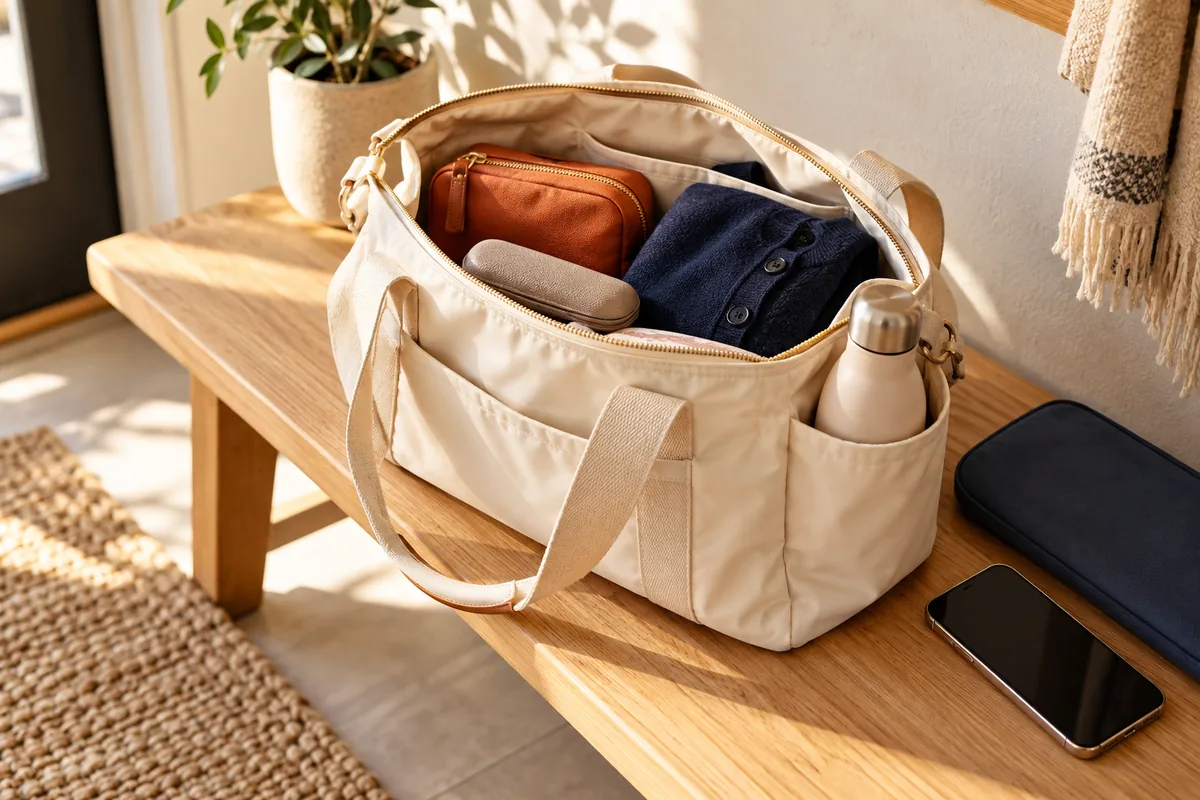
Cover image: AI-generated illustration for BoardingNotes.
Jump to: Bag allowance · Packing list · Access groups · Gate-check backup · Route rules · Final check · FAQs
1. Check what your booking actually allows
A personal item is usually the smaller bag intended for the space under the seat in front of you. A larger carry-on normally uses the overhead bin. Airlines may use different names, and an international ticket does not automatically include both.
Read your booking and the operating airline’s baggage page for the number of bags, packed dimensions, weight limits, and any combined cabin-baggage weight. Check connecting flights and the return journey too. The carrier selling the ticket may not operate every flight.
For example, British Airways lists a handbag or backpack limit of 40 × 30 × 15 cm for its own flights and says it must fit under the seat. It also warns that partner-airline allowances can differ. That is an airline-specific example, not a universal personal-item size.
Measure your bag when packed, including bulging pockets and protruding parts. A soft bag stops being compact when you fill every compartment. Keep any extra purse or crossbody bag inside the permitted bag when required; wearing it does not automatically make it exempt.
Check storage instructions for your assigned seat, particularly if there is no seat directly in front. Follow crew directions during taxi, takeoff, and landing. An underseat packing plan is not a promise that the bag can stay at your feet throughout every flight.
2. Build your personal item packing list
Start with the items you personally need. The table gives each one a job and a practical location; it does not mean you need to pack every row. Keep the list beside your open bag and remove anything that duplicates an item you already carry.
| Item or group | Why it belongs | Where to reach it | Choose for your trip |
|---|---|---|---|
| Passport and required documents | Identification and entry or transit checks | Secure zipped pocket or slim sleeve near the opening | Original documents plus the records your itinerary requires |
| Phone and boarding information | Boarding, messages, and onward plans | Protected pocket you can reach easily | Save permitted digital passes and key details offline; carry required paper versions |
| Payment method and backup | Transport, food, and unexpected expenses | Closed wallet; backup in a separate secure place | Another usable card or modest cash if appropriate |
| Personal medication and accessibility essentials | Needs that cannot wait for a suitcase | Protected, identifiable pouch; urgent items within easy reach | Include necessary documentation and confirm carriage conditions |
| Glasses and necessary vision supplies | Reading, navigation, and personal care | Hard case near the top | Spare glasses or contact supplies if you use them |
| Charging cable and wall charger | Power during airport stops and after arrival | Small pocket or pouch | Compatible connections; plug adapter only where needed |
| Power bank or spare batteries | Optional backup power or device needs | Individually protected, accessible cabin location | Only compliant items; check capacity, count, storage, and use rules |
| Compact hygiene supplies | Small personal-care needs | Easy-to-remove pouch and required liquids bag | Tissues, toothbrush, permitted small liquids, menstrual supplies as needed |
| Water bottle and snack | Something suitable between services | Secure bottle pocket; food in a small separate bag | Empty bottle for screening where required; check food restrictions |
| Light layer and chosen comfort items | A warmer layer or quieter break | Near the opening | One layer, headphones or earplugs, and an eye mask only if useful |
| Minimal spare clothing | A practical fallback after spills or baggage delays | Small pouch deeper in the bag | Underwear, socks, and a light top; add more only for a clear need |
| Laptop, tablet, or other valuable device | Work or personal tasks you actually expect to do | Padded sleeve with easy removal | Bring fewer devices if one can cover the job |
Keep the backup useful, not bulky
Think about the first evening without your main luggage. A change of underwear, your essential toiletries, and a clean top may be enough for one traveler; another may need additional clothing or equipment. Choose around your needs and available space rather than packing a second wardrobe.
Do not shrink necessary medical supplies to make room for optional clothing. If essential equipment needs more space, contact the airline about its arrangements before travel instead of assuming it must fit inside a standard personal item.
A phone may already cover reading, music, boarding information, and messages. Add a tablet or laptop when it has a separate purpose. Likewise, bring the cable that works with your device, not an entire drawer of spare connectors.
3. Give everything a predictable place
You do not need a matching set of organizers. Existing zipped pockets, a small pouch, and a simple clothing bag can create a workable system. Different colors or textures help you identify them by touch, especially in a dim cabin.
Group one: documents and boarding access
Use a secure compartment near the main opening for your passport and necessary travel paperwork. Keep it separate from food and liquids. An open outer pocket may be convenient, but it is a poor home for something you cannot afford to lose.
Give your phone and wallet consistent positions, then return them there after each use. Save your first accommodation address, transfer details, and essential contact information offline. Copies can help with recovery, but they do not replace an original passport or another required entry document.
A backup card in a different closed pocket is useful if the main wallet is misplaced; it will not protect you if the entire bag disappears. Keep only the sensitive records you need, protect your phone with a lock, and avoid leaving private documents open on a tray or seat.
Group two: the things you will use in your seat
Place a small flight-use pouch near the top: perhaps headphones, tissues, glasses, and a lip-care product that meets the applicable rules. A light layer can sit beside it. Keep drinks closed and separate from electronics and paperwork.
Pack according to your own use pattern. If you will need a medication promptly, put it where you can reach it, regardless of the group it belongs to on paper. Only take out what you need; loose items multiply quickly in a small seat area.
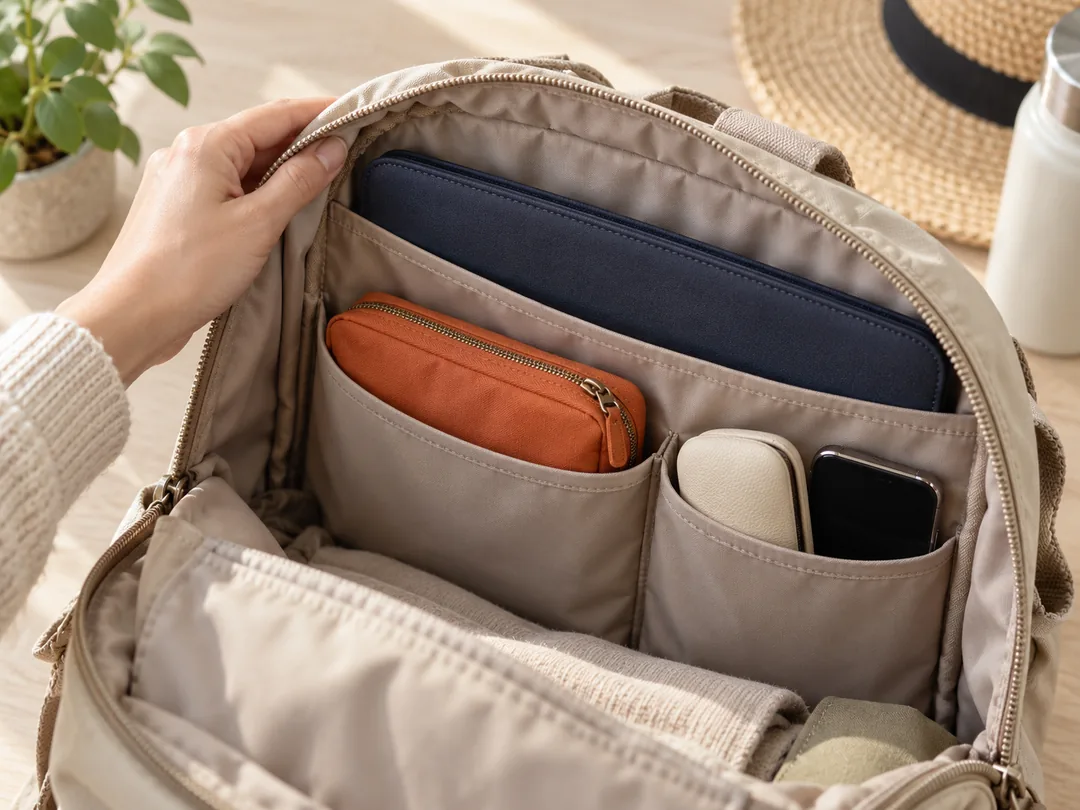
Group three: the essentials that stay with you
Protect the rest of your medication, valuable devices, and small clothing backup within the bag. Clothes you are unlikely to need in flight can sit lower down. Keep approved power banks accessible and individually protected, following your airline’s storage instructions rather than burying them beneath everything.
Finally, sit in a chair with the packed bag in front of you. Can you retrieve your document sleeve, glasses, and flight-use pouch without unpacking? If not, move them. This checks your organization, not whether the bag meets an aircraft’s underseat dimensions.
4. Be ready if your larger carry-on is gate-checked
Your smaller bag should already contain the things you cannot lose access to. Leave a little spare room so you can move an essential item out of the larger bag if necessary, while still meeting your cabin allowance.
Before handing over a bag, remove your documents, medication, valuables, necessary devices, and immediate-use items. FAA guidance requires power banks and spare lithium batteries to stay in the cabin, including when a carry-on is checked at the gate. Protect them against damage and short circuits.
Tell the agent if you cannot safely separate or accommodate a required medical device or battery. Do not hand over the bag first and assume you can retrieve something later. Ask where the checked bag will be returned, because you may not see it again during your connection.

5. Check the rules that change by route
Airline baggage allowance, security screening, and border entry are separate checks. An item that fits in your bag and passes departure security can still face restrictions at a connection or destination. Check official instructions close to departure.
Power banks: carrying is different from using
ICAO’s March 27, 2026 change limits passengers to two power banks and prohibits recharging the power banks during flight. IATA’s passenger guidance uses a maximum of two, each no more than 100 Wh, and notes that airlines may be stricter.
Check the capacity printed on yours. Do not assume a larger power bank qualifies under an approval exception for other spare batteries. For example, British Airways caps power banks at 100 Wh and requires them in a seat pocket or a bag under the seat.
Recharging a power bank from the aircraft and using it to charge your phone are different actions. IATA’s explanation of the ICAO change distinguishes the recharge prohibition from a recommendation against using one to power a device. Confirm your airline’s use rules; permission to carry one is not permission to use it onboard.
Keep batteries separately protected from keys and other metal, and leave damaged or recalled unsafe batteries at home. If a device overheats, swells, smokes, or burns, alert the crew immediately. Pack for the published carrier rules, not a generic “airline-approved” label.
Liquids and security screening
For U.S. TSA screening, the standard liquids rule permits containers of 3.4 ounces (100 mL) or less within one quart-sized liquids bag per traveler. Creams, gels, and pastes count too. Keep that bag easy to remove if instructed.
Other checkpoints can differ. UK guidance says the rules depend on the airport and advises checking departure, transit, and return airports. Do not use a relaxed outbound rule as proof that the same bottle will pass elsewhere. Packing ordinary toiletries in 100 mL-or-smaller containers is a practical starting point, not a guarantee of acceptance.
TSA allows medically necessary liquid exceptions in reasonable quantities, with declaration for inspection. Check the equivalent process elsewhere. Follow the local screening instructions for liquids, electronics, and medical equipment; do not assume everything must always come out.
Medication and personal equipment
CDC recommends checking medicine rules for your destination and layover countries. Keep medicines in original labeled containers, bring prescription copies, and confirm any permits or quantity limits. Pack enough for the trip and possible delays within those requirements.
Ask your pharmacist or clinician about storage needs and your airline about carriage of related equipment. An insulated pouch alone does not establish that temperature-sensitive medicine will remain within its required range.
Food and water
Choose a small snack suited to your dietary needs and route. TSA generally permits solid foods, while liquid or gel foods face liquids limits. A spread or yogurt does not become a solid-food exception because it is a snack.
A reusable bottle can travel empty through TSA screening and be filled afterward where suitable water is available. Check later checkpoints too. At arrival, follow the destination’s food rules: USDA requires agricultural products to be declared when entering the United States. Factory packaging does not automatically make food admissible.
6. Remove the extras and close the bag
Lay out anything you have packed “just in case.” A second bulky layer, several entertainment devices, a full cosmetic bag, and extra chargers can crowd out the items you need to reach. Remove duplicates before buying more organizers.
Use this compact check after everything is inside:
- Allowance: the packed bag meets every relevant carrier’s dimensions, count, and weight requirements.
- Access: you can reach documents and immediate-use essentials without unpacking.
- Protection: liquids are contained; devices, glasses, and batteries have suitable protection.
- Route: security, medication, food, and battery conditions have been checked.
- Independence: losing access to the larger bag would not separate you from critical items.
- Space: the bag closes easily and remains manageable to carry.
Frequently asked questions
Does a backpack count as a personal item?
It can if it meets your booking’s allowance, packed dimensions, weight, and storage requirements. The word “backpack” on a product page does not decide its airline category. Check the operating carrier’s rules for your flight.
Can I bring a personal item and a carry-on internationally?
Some fares allow both; others include only one smaller bag. Check each operating airline and your fare rather than assuming that an international route includes a larger carry-on.
Should toiletries go in my personal item or carry-on?
Put the small supplies you need during travel, and anything you cannot lose access to, in your personal item. Keep liquids accessible for screening. The rest can go in your larger bag if allowed, without duplicating your entire toiletry kit.
Do I need packing cubes for a personal item?
No. Built-in pockets and a few lightweight pouches may be enough. Use a small clothing pouch if it helps, but avoid filling the bag with organizers that add bulk or hide frequently used items.
Make your smaller bag easy to live out of
Keep critical items with you, give frequently used things a consistent home, and leave space for the unexpected. A well-packed personal item lets you find what you need with less searching, whether you are boarding, connecting, or arriving without immediate access to your suitcase.