
Packing for a week starts with deciding what you will actually wear and use—not filling every corner of your suitcase. This carry-on packing list for 1 week gives you a practical system for clothing, toiletries, electronics, and the essentials you need close at hand.
The sample wardrobe suits a mild-weather trip with mostly casual activities. Adjust it for your plans, personal needs, and laundry access. It assumes your ticket allows a carry-on and a personal item; check that allowance first. The goal is a workable bag, not the smallest possible one. For cooler conditions, adapt the clothing section with the fall travel capsule wardrobe.
At a Glance: Your 1-Week Packing Checklist
Clothing, including what you wear on the plane: 5 tops, 2 bottoms, 1 outer layer, 7 pairs of underwear, 5 pairs of socks with laundry planned, 1 sleepwear set, and up to 2 pairs of shoes.
Toiletries: Your daily basics in suitable small containers, a toothbrush, toothpaste, deodorant, sunscreen, and any personal-care essentials.
Electronics: Phone, compatible charger and cables, headphones, an optional power bank, and an adapter when needed.
Keep close: Accepted ID, travel documents, payment options, medicines, and valuables.
Before closing: Check the packed dimensions, weight, liquids, and battery rules for your itinerary.

Start With the Right Bag: Size, Weight, and What Your Fare Includes
Check three things separately: the permitted dimensions, the weight allowance, and whether your fare includes an overhead-bin bag. A suitcase marketed as “carry-on size” is not a promise that it meets your airline’s policy.
For example, American Airlines lists a limit of 22 × 14 × 9 inches, including wheels and handles. Frontier lists 24 × 16 × 10 inches and up to 35 pounds, but an overhead-bin bag is not included with every fare. These are airline-specific examples, not a universal standard.
Measure the bag when packed, including projecting parts and bulging pockets. An expansion zipper does not create extra baggage allowance: the expanded bag still needs to meet the rules on your outbound and return flights.
Plan your two bags together:
- Carry-on: Clothes, your packed shoes, and nonessential toiletries.
- Personal item: Documents, medicines, valuables, electronics, and anything you need during the flight.
Your personal item also needs to fit the airline’s allowance. Keep the combined setup manageable enough to move through the airport without repeatedly unpacking it. On a connecting itinerary, check each operating airline rather than relying only on the carrier that sold your ticket.
The Clothing Formula: A Small Wardrobe for 7 Days
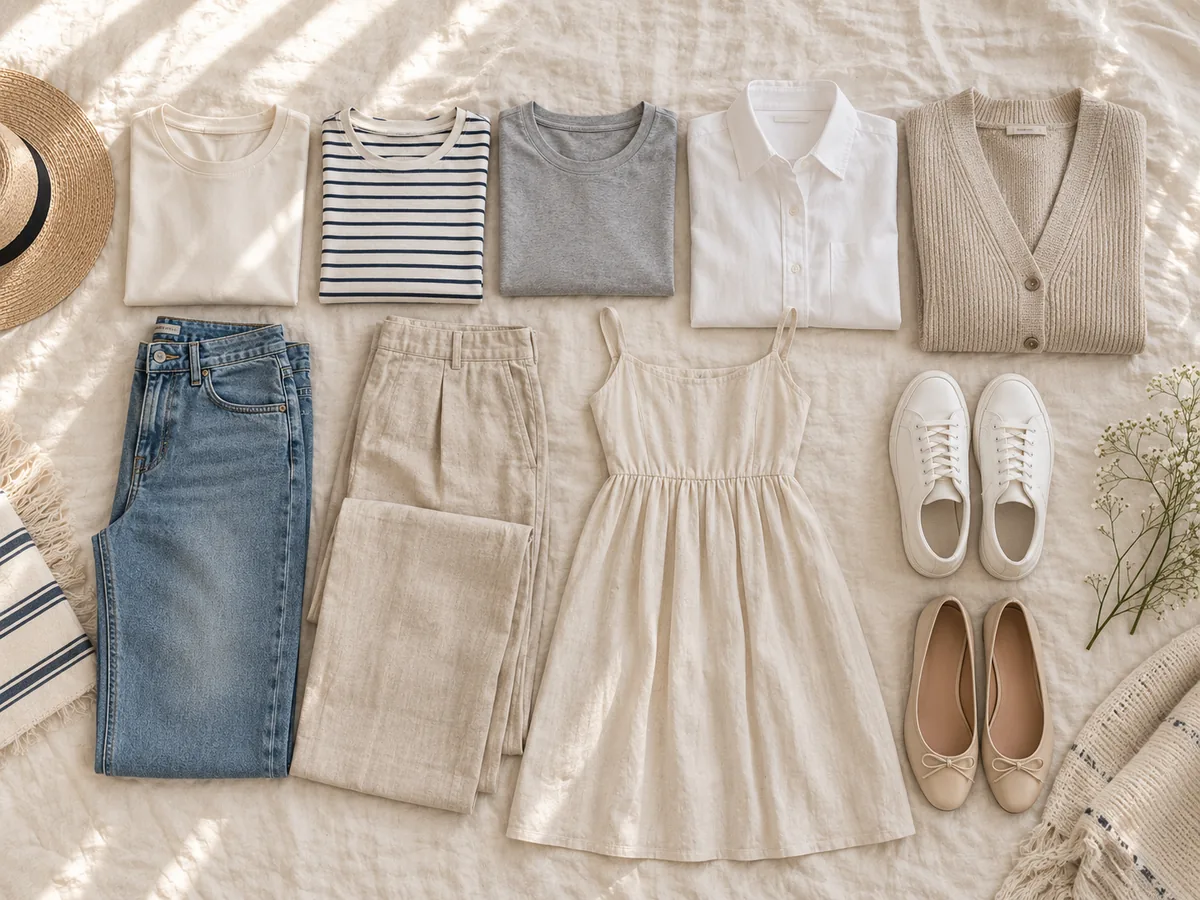
Instead of seven separate outfits, build a wardrobe whose pieces work together. Start with familiar clothes you already like wearing, then choose a small color palette.
The totals below include your flight outfit. Wearing one of your five tops means packing the other four—not taking a sixth.
| Item | Total for the trip | How to use the allowance |
|---|---|---|
| Tops | 5 | Include one that works for a nicer meal. |
| Bottoms | 2 | Wear one and pack one. |
| Outer layer | 1 | Choose for the forecast and your activities. |
| Underwear | 7 pairs | Add what your actual needs require. |
| Socks | 5 pairs | Plan a wash or take more for daily wear. |
| Sleepwear | 1 set | Keep it light enough for your accommodation. |
| Shoes | Up to 2 pairs | Wear the bulkier pair; pack the other. |
Try each top with both bottoms before packing. For a dinner out, start with the smartest combination you already have. Add a separate dress or outfit only when your plans genuinely call for it.
Five tops are a starting point, not a hygiene rule. Rewear only what is comfortable and clean enough for you. A mid-trip laundry session can help, but allow drying time; washing the night before moving hotels is not always practical. Add socks when you will wear them daily without washing.
Roll soft clothing if that fits your bag neatly, and fold structured pieces. Packing cubes can keep categories separate, but they are optional organizers—not a requirement or a guarantee of extra space. Use a pouch or bag you already own if it does the job.
For cold weather, workouts, swimming, or specialist activities, adapt the list before packing rather than forcing unsuitable clothes into it.
Toiletries: Pack Small and Check the Liquids Rules

At U.S. TSA checkpoints, the usual liquids rule allows containers of 3.4 fluid ounces (100 milliliters) or less, together in one clear, quart-size bag per passenger. The container capacity matters, not how much remains inside. Toothpaste, creams, and gels count too. See the TSA liquids guidance and Delta’s published screening summary.
Build your kit around what you actually use:
- Toothbrush and travel-size toothpaste.
- Shampoo, conditioner, and body wash only when needed.
- Deodorant, cleanser, moisturizer, and enough sunscreen for your plans.
- Personal-care items such as menstrual products or your usual contact-lens supplies.
- A razor, if needed, and a compact first-aid kit suited to you.
Check your accommodation’s amenities before leaving products behind. Do not assume every hotel or rental supplies suitable shampoo, towels, or a hairdryer. Choose refillable containers only when appropriate for the product, label them, and check for leaks before packing.
A larger hanging wash bag may hold dry items, but its built-in clear pocket is not automatically an acceptable liquids bag. Check the actual size and arrangement.
For U.S. screening, TSA lists disposable razors as permitted in carry-on bags, while loose razor-type blades are prohibited. Check the guidance for your exact razor type rather than assuming all razors follow one rule.
Keep medical needs separate from toiletry cuts. TSA provides exceptions for medically necessary liquids, including quantities above the usual limit. Follow the relevant screening instructions instead of leaving necessary supplies behind.
Outside the U.S., check the airports on your route, including your return. UK guidance explicitly says liquids rules depend on the airport; one airport’s arrangements are not a worldwide rule.
Tech and Electronics: Keep It Useful, Keep Batteries Accessible

Start with a compact kit:
- Phone, compatible wall charger, and required cables. Add a spare essential cable if useful.
- Earbuds or headphones. Choose the pair you actually use.
- Power bank, if needed. Check its labeling and your airline’s policy.
- Travel adapter, when required. Match it to the destination and your devices.
- Laptop, tablet, or camera only when it serves a real purpose. Work, accessibility, entertainment, and photography are all valid reasons.
Keep the kit together in a small pouch. Do not add a second charger for every device without checking whether your existing equipment can handle the job.
Power banks need special attention. Under FAA guidance, power banks and spare lithium batteries must stay in the cabin and be protected from damage and short circuits. If your carry-on is taken at the gate for loading into the hold, remove them first. The FAA describes an approval route for some larger spare lithium-ion batteries, but do not treat that as permission for a larger power bank. IATA’s 2026 passenger guidance limits power banks to two, each no more than 100 Wh. Check the operating airline’s current policy; other spare batteries follow separate rules. Separately, ICAO specifications effective 27 March 2026 limit passengers to two power banks and prohibit recharging the power banks themselves during flight. Check your operating airline’s capacity, quantity, storage, and onboard-use rules. See FAA PackSafe and ICAO’s power bank guidance.
Keeping the power bank accessible in your personal item makes that last-minute transfer easier. Do not pack a damaged or recalled battery.
Documents and Money: Keep Essentials With You
Use one secure, easy-to-reach place in your personal item for:
- Passport and any required visas or travel authorizations.
- An ID accepted for your flight. For U.S. screening, check TSA’s identification list, not just whether you have a government-issued card.
- Boarding pass saved for offline access, plus a paper backup when useful.
- Payment card and an available backup, stored separately.
- A sensible amount of cash for your arrival plans.
- Accommodation address, booking details, and insurance information, if applicable.
- Essential medicines and a secure backup of important documents.
Keep those document copies separate from the originals and protect access to digital versions. A copy is a backup, not a substitute for the travel document itself.
What to Leave Home—and What Not to Cut
Make space by removing duplication, not by ignoring your needs.
Extra outfits without a purpose. Keep a reasonable contingency, but question three versions of the same dinner outfit.
Bulky toiletry containers. Bring suitable smaller amounts of ordinary products. Do not use this as a reason to cut necessary medicines or supplies.
A third pair of shoes. Check whether your two planned pairs cover the actual activities. Keep specialist footwear when the trip requires it.
Unnecessary towels or hair tools. Leave them only after checking what your accommodation provides and what suits you.
Duplicate books, chargers, and organizers. Pick what you will use. You do not need to buy new travel accessories to make an existing setup look tidy.
Rain gear chosen by habit. Decide between a rain jacket, compact umbrella, or both based on your forecast and activities—not a blanket packing rule.
For a borderline item, ask: When will I use this? Do I already have something that does the job? Would replacing it be easy and affordable for me?
Do not apply that test to irreplaceable, medical, accessibility, or safety essentials. A practical bag should support your trip, not turn it into an endurance exercise.
International vs. Domestic: What Changes
The basic packing system stays the same. For an international trip, add these checks:
Bag policies for every flight. Check dimensions, weight, and fare inclusions, especially when changing airlines. Do not assume a U.S. domestic flight is weight-free either; Frontier publishes a cabin-bag weight limit.
Plugs and power. A plug adapter does not itself convert voltage. Check the input rating on each device or charger, plus the destination’s supply and socket type. Follow the manufacturer’s instructions for anything incompatible. Electrical Safety First explains these distinctions.
Documents and medicines. Check entry requirements for your passport nationality and itinerary instead of applying a universal passport-validity rule. Before traveling with medicines, check destination restrictions and documentation needs; the U.S. State Department’s medicine guidance is a useful starting point for U.S. travelers.
Your Pre-Trip Packing Routine
A day or two before departure, work through this sequence:
- Check your plans. Review the forecast, booked activities, laundry access, and baggage allowance.
- Lay out the wardrobe. Set aside your flight outfit before counting what goes into the suitcase.
- Pack clothing by category. Use cubes or your preferred arrangement; keep worn laundry separate later.
- Bag the packed shoes. Use small gaps for soft items without squashing fragile equipment.
- Keep screening items reachable. Position your liquids bag so it can be removed when requested.
- Load your personal item. Add documents, medicines, valuables, electronics, and flight essentials.
- Measure and weigh the finished setup. Include the final contents of both bags where relevant to your allowance.
- Check the gate-check plan. Know what to remove if your main bag is taken before boarding.
Close the bag without forcing the zipper. Then carry the whole setup briefly: it should be manageable for you, not merely fit on paper.
FAQ: Carry-On Packing for a 1-Week Trip
How many outfits should I pack in a carry-on for 7 days?
Start with 5 tops, 2 bottoms, and 1 outer layer, including your flight clothes. Coordinate them and plan laundry or comfortable rewearing. Add what your activities and personal needs require instead of treating the quantities as a fixed rule.
Can I really fit a week of clothes in a carry-on?
Often, yes, for a mild-weather trip with a compact wardrobe. The result depends on your bag allowance, clothing bulk, equipment, and needs. A checked bag is reasonable when those do not fit comfortably.
What is the 3-1-1 rule for carry-ons?
At U.S. TSA checkpoints, ordinary liquids go in containers no larger than 3.4 fluid ounces (100 milliliters), inside one clear quart-size bag per passenger. Exceptions include medically necessary liquids; use the screening guidance linked above.
Do airlines weigh carry-on bags?
Airlines may check weight as well as dimensions. Look up your carrier’s published allowance rather than relying on what happened on a previous flight. Check whether any limit applies to one bag or a combined cabin allowance.
Final Packing Check
Before you leave, confirm your bag allowance, accepted ID, liquids arrangement, and accessible batteries. Everything else should have a clear purpose. The best packing list is the one you can use comfortably—not the one with the fewest items.