Long-Haul Flight Essentials: What to Pack for a More Comfortable Trip
The most useful long-haul flight essentials solve a problem you actually notice: light when you want to rest, a chilly cabin, uncomfortable clothing, or hours without anything you want to watch. Start with those needs, then choose a small set of familiar items that you can use comfortably in your seat.
This guide focuses on choosing and using comfort items during the flight. It is not a complete personal-item packing list. You do not need every accessory below, and you may already own most of what will help. Use the one-week carry-on packing list for the rest of your bag and the international travel checklist for preparations before departure. Follow the airport and flight-day checklist for check-in, security, boarding, and arrival steps.
At a glance: build a useful comfort set
Start with the basics: comfortable clothes, a removable layer, your everyday personal-care needs, and something enjoyable to do offline.
Add for your own needs: an eye mask, earplugs or headphones, a support pillow that fits you, and a small snack if it suits your journey.
Check before relying on it: aircraft power, entertainment, meal service, power-bank rules, and permission for any accessory that attaches to or occupies space around the seat.

Cover: AI-generated illustration for BoardingNotes; conceptual cabin, not a specific airline.
Start with your flight and your biggest discomfort
Think about how you expect to spend the journey. An overnight flight may make light control and a comfortable resting position priorities. On a daytime flight, reading, watching something, and changing position may matter more. Neither plan needs a bag full of gadgets.
Check the operating airline and the cabin on your booking for these details:
- Whether meals, a blanket, a pillow, or headphones are included.
- Whether entertainment uses a seatback screen or your own device.
- What charging connections and Wi-Fi, if any, are available.
- Whether your preferred seat accessory is permitted.
For example, British Airways says charging facilities vary by aircraft and cabin. Treat a general airline amenities page as a starting point; check your particular flight and keep a workable option if a screen, socket, or connection is unavailable.
Then name your two biggest discomforts. If they are noise and feeling cold, your existing headphones and a cardigan may deserve space before a new travel pillow. If a familiar item already solves the problem, there is no need to replace it with a travel-branded version.
Choose your long-haul flight essentials by need
Use this table to select your set, not to collect every item. “Basic,” “optional,” and “check first” are practical planning labels here, not airline classifications.
| Need | Item type | When it helps | What to check |
|---|---|---|---|
| Temperature comfort | Basic: removable layer | You want warmth without changing your whole outfit. | It feels comfortable while seated and is easy to remove. |
| Less light | Optional: eye mask | You want to rest while nearby lights remain on. | Strap tension, eye clearance, and fit with your pillow. |
| Less distracting sound | Optional: earplugs or headphones | Noise bothers you or you want personal audio. | Longer-wear comfort, battery needs, and crew instructions. |
| Head or neck support | Optional: travel pillow | Your usual seated resting position needs support. | Fit while upright and packed bulk. |
| A simple refresh | Basic: selected personal-care items | You want to brush your teeth or freshen up. | Security limits and what you personally use. |
| Something to do | Basic: downloaded entertainment or reading | You want a dependable choice beyond the onboard offering. | Downloads open offline and devices are charged. |
| Food and drink flexibility | Optional: bottle and suitable snack | Service timing does not match your preferences. | Security, dietary needs, and arrival restrictions. |
| Extra power or seat support | Check first: power bank or accessory | It fills a specific gap in your plan. | Carrying permission and onboard-use permission separately. |
Make rest more comfortable without overpacking
Choose a mask you can leave on comfortably
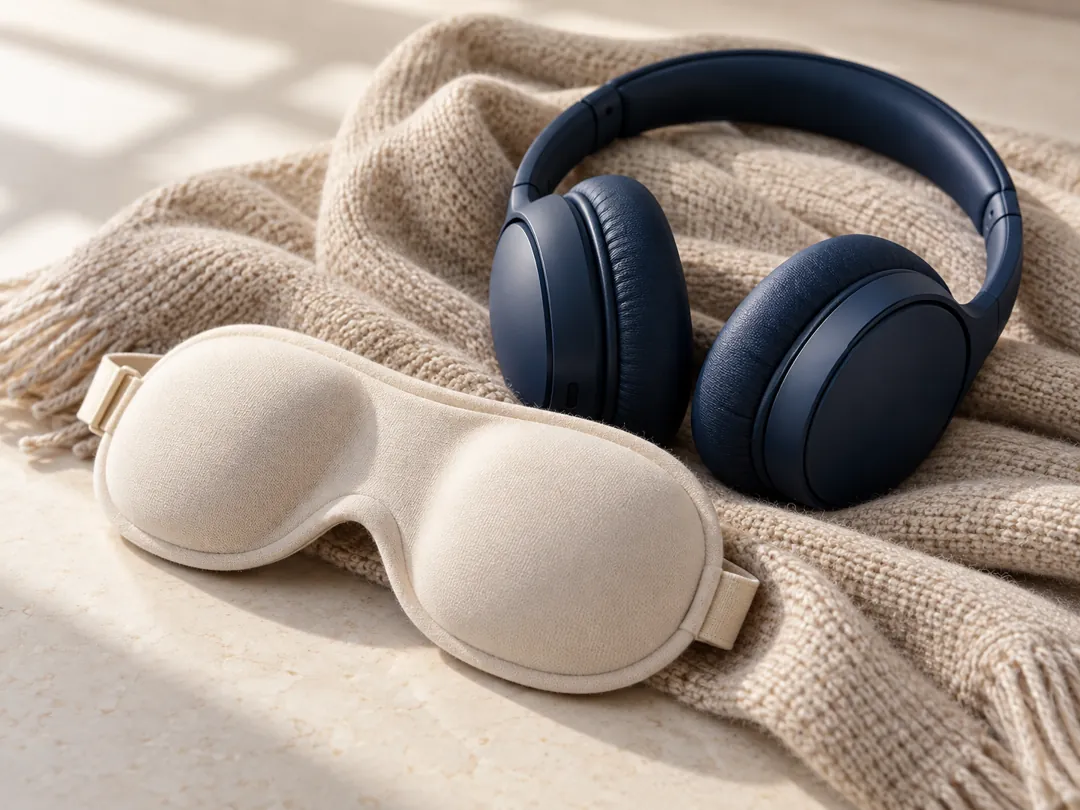
A soft, flat eye mask takes little space. A contoured mask offers more clearance around the eyes but can be bulkier. Either can be a reasonable choice; the useful test is whether it stays comfortable when you lean back or turn your head.
Try the strap at home with your usual hairstyle and the support you intend to use. If you keep lifting the mask because it presses or slips, it is unlikely to become more appealing after several hours in a seat. A mask can reduce light; it cannot guarantee sleep.
Compare earplugs, earbuds, and over-ear headphones
Earplugs are compact and need no charging. Use a type you already find comfortable and follow its fitting instructions. They may be enough if you mainly want a quieter resting period rather than music or films.
Earbuds save space and are convenient for personal audio, but pressure can become noticeable when you lean against a pillow. Over-ear headphones take more room, and their ear cushions can feel warm or awkward against a headrest. Noise-canceling models add another battery to charge before departure.
Test whichever option you own while sitting and leaning back. Carrying headphones plus a tiny pair of earplugs can make sense if they serve different purposes; bringing several audio devices “just in case” usually needs a clearer reason. Remove headphones for the safety briefing and follow crew directions throughout the flight.
Test a pillow while sitting upright
Choose support for the way your head tends to rest, rather than choosing by appearance. A thick U-shaped pillow may feel supportive around the sides yet push your head forward against a seatback. Inflatable versions pack smaller and let you adjust firmness, but their shape and seams may not suit you.
Before packing one, sit upright with it for a while, turn your head, and notice whether you can relax without forcing your chin into an uncomfortable position. Try it with your mask and headphones together. If the combination feels crowded, remove a component. Your airline’s small pillow may be sufficient for your preference if one is provided.
Once settled, keep your setup within your own space. Follow instructions for seat position and stowing items, and keep your seat belt fastened while seated. A simpler setup is easier to put away for a meal or when the crew needs the area clear.
Choose comfortable clothes and leave room to move
Wear clothes that feel comfortable at the waist, knees, and shoulders when you sit for a while. Soft trousers, a familiar top, and a removable cardigan or light sweatshirt are a practical starting point. Test the full outfit seated, including any belt or waistband.
A wrap can double as a light extra layer, but keep it contained rather than trailing into shared space. Choose shoes you can walk in and put back on easily. Cozy socks are optional for warmth; they do not replace footwear when you move around the cabin.
Comfort equipment does not replace movement
CDC travel guidance recommends occasional walking and calf-muscle exercises during long periods of sitting. When the seat-belt sign is off and the crew says it is safe, take opportunities to stand or walk. While seated, simple heel raises, toe raises, and tightening and releasing the leg muscles are examples in that guidance.
Leave enough usable space to change position. Do not build a nest of belongings that makes standing up difficult. If you have risk factors for blood clots, discuss your journey with a healthcare professional before departure, including whether fitted compression stockings are appropriate. They are not a required purchase for every traveler, and ordinary warm socks are not the same thing.
Keep hygiene, water, and food simple
Bring the refresh items you will actually use
A toothbrush, a small amount of toothpaste, tissues, and your usual lip balm may cover your needs. Add a familiar moisturizer, deodorant, or menstrual supplies if useful for you. Choose small quantities and secure lids; an elaborate skincare routine adds bottles without necessarily adding comfort.
Keep strongly scented products to a minimum in a shared cabin. A quick, familiar routine is easier than spreading several items across a tiny washbasin. You can also save the fuller refresh for the terminal after landing.
Check the liquid rules at departure and any transfer screening point. At U.S. TSA checkpoints, ordinary carry-on liquids, gels, and aerosols must be in containers of 3.4 ounces (100 milliliters) or less within one quart-size bag per passenger. That is a U.S. screening rule, not a universal description of every airport. Check separate guidance for medically necessary liquids.
Have a practical water and snack plan
If you use a refillable bottle, take it empty through checkpoints where ordinary liquid limits apply, then fill it where drinking water is available. Another option is water obtained after screening. Additional screening may happen before boarding, so follow local instructions even after an earlier checkpoint.
Drink normally for your needs and follow any personal medical advice about fluids. Do not treat a water bottle as a blood-clot prevention device: the CDC Yellow Book says hydration cannot specifically be recommended to prevent travel-associated clots.
For snacks, choose a modest portion of something familiar, low-mess, and suitable for your dietary needs. Check the airline’s meal information, including any special-meal request deadline, before relying on cabin service. Food allowed through security may still face arrival restrictions. For U.S. entry, USDA APHIS requires agricultural products to be declared; check destination rules before carrying leftover food off the aircraft.
Prepare entertainment that works offline
Choose a small variety rather than downloading everything. One film, a few podcast episodes, and something to read can give you options when your mood changes. A paperback needs no battery; an e-reader can hold several choices without the weight of multiple books. Use what you already enjoy.
Open your chosen downloads in airplane mode before leaving. Check that video, audio, and reading apps do not need a fresh sign-in or license check. Downloading something is not the same as confirming it will play offline.
If you will use your own headphones with a seatback screen, check the airline’s connection information before buying an adapter. Do not assume a Bluetooth-only pair will connect. For personal-device entertainment, confirm whether the airline requires an app and install it ahead of time if needed.

Separate charging your phone from carrying a power bank
Charge devices before departure and bring the cable that matches the connections you expect to use. If aircraft power is available, it may be slow or unavailable at your seat. Lowering screen brightness to a comfortable level and keeping some reading available can reduce how much your plan depends on charging.
A power bank is a conditional addition. Three separate questions matter: can you carry it, where must it stay, and can it be used during the flight?
- Cabin carriage: FAA guidance requires power banks and spare lithium batteries to remain in cabin baggage, including when another bag is checked at the gate. Protect them against damage and short circuit, and check the airline’s capacity and quantity limits.
- Recharging the bank: ICAO’s specifications effective March 27, 2026 limit passengers to two power banks and prohibit recharging them during flights. Your airline can be stricter.
- Using the bank to charge a device: check the operating airline separately. For example, Qantas prohibits both using and charging power banks during flight. Carrying permission does not mean permission to plug one into your phone.
Do not depend on a power bank as your onboard charging solution until you have checked every operating carrier on your itinerary. Keep it accessible as directed, and tell the crew immediately if a battery or device becomes hot, swells, or smokes.
Leave space by questioning the optional extras
Before adding another item, ask: what specific discomfort will this solve, and is something already in my set doing that job? A cardigan and a large separate blanket may be unnecessary together. A tablet, e-reader, and several paperbacks may be more entertainment weight than you want to carry.
Be especially cautious about buying foot hammocks, inflatable supports, or anything that attaches to a seat. Qantas lists leg hammocks among prohibited accessories and restricts devices that attach to seats or block access. Rules can differ by airline, accessory, and seating position; permission for a particular child’s inflatable device does not establish permission for an adult footrest.
Keep an unfamiliar gadget out of the set until you have tested it at home. The same principle applies to new “sleep” products: this guide does not recommend adding sleep medicines, aspirin, or melatonin to make the journey easier. Discuss medication questions with your healthcare professional.
Use a small landing reset
Before the crew starts preparing the cabin for landing, take a moment to put your comfort items away. If the seat-belt sign is on or time is short, save any washroom routine for the terminal.
- Pause your entertainment and disconnect permitted charging cables.
- Collect headphones, mask, pillow, and loose personal-care items.
- Put on your shoes and adjust your layers for arrival.
- Check the seat pocket and the area around you for belongings.
- Secure your bottle and remaining food; remember arrival restrictions.
- Stow devices and accessories as directed and keep the footwell clear.
This short reset is easier when you have only a few useful items out. It also makes it less likely that a small earbud case or charging cable stays behind in the seat.
Frequently asked questions
What are the most useful long-haul flight essentials?
Start with comfortable clothing, a removable layer, your basic personal-care items, and offline entertainment. Add a mask, earplugs or headphones, and a pillow only where they solve a real need. Check what your flight provides before duplicating it.
Do I need a travel pillow?
No. It is useful only if its shape improves your seated resting position enough to justify carrying it. Try it at home with your mask and headphones, and consider whether the airline’s provision is sufficient for you.
Are compression socks essential for a long flight?
They are not a universal requirement. If you have blood-clot risk factors or questions about compression, ask a healthcare professional about suitability and fit before traveling. Keep movement in your plan when conditions and crew instructions allow.
Can I use a power bank during the flight?
Only if the operating airline permits that use under its current rules. Some airlines prohibit it even when carrying a compliant power bank is allowed. Do not recharge the power bank in flight, and check the separate carriage and storage requirements.
Pack for the comfort you actually need
A useful flight set starts with familiar items and a realistic plan. Test the fit, prepare something enjoyable offline, check the airline’s rules, and leave yourself room to move. Every extra should earn the space it takes.